
1080 Avalanche
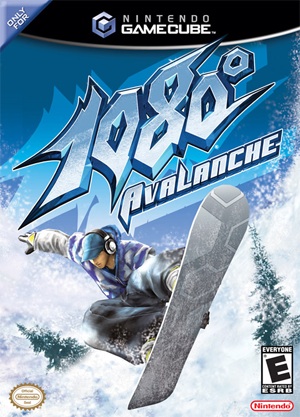
1080 returns to the slopes for another snowboarding run, but is it better than the original or does it fall victim to sequelitis?
1080, Nintendo’s revolutionary snowboarder, has returned to the slopes in this Gamecube sequel to the N64 classic that was released on December 1, 2003 by Nintendo Software Technology [NST] and Nintendo themselves. However the game has been remodeled, retooled, and basically given a complete makeover this time, most likely due to the fact that…well…the Gamecube and its optical discs can handle more game data than the N64 and its cartridges could. Now before you ask: yes, the game is “essentially” the same as 1080 for N64 as both have the same stunt modes and Match Race mode is still where you unlock new tracks. “Essentially” is the operative word here as these are the only basics that were carried over from the N64 game, everything else has been changed. These changes include different characters/character models, new tracks, a more realistic feel to the game, easier controls etc. Let’s also not forget that the game advertises “changing environments” that the player can trigger while riding down the mountain. The two questions you may be asking now are most likely “Does it work and does it improve upon 1080?” or “Does this game leave you feeling short changed?” Join me in my tenth review (coincidentally. XD) as I discuss the answers to these questions, won’t you?
First, as usual, we’ll discuss the graphics. The graphics in this game look great and really help to accentuate the more realistic feel that Nintendo was going for with this game. Note that realistic means environments that look like actual mountain slopes or backwoods…or train tracks…or a city icefest…wait what was that last one again? Anyways, even the remodeled characters look somewhat more realistic as well. I also liked how the scenery in 1080 Avalanche realistically reacted to the weather of the track/time of day you were racing on the track as well. This is opposed to the original N64 game where either the sun was glaring off of the snow, stormy tracks seemed bright, or the track was very dark because you were racing at night [to name a few graphical shortcomings]. The animation [read: object movement] in the game also looks very smooth as well. Gone are the stiff movements from the original, the characters now move like an actual person would and the environment makes realistic changes as well. Lastly, I’d like to note that the special effects in the game (rumbles from explosions/avalanches, blurs for moments that your character lands a jump off balance) also look neat and really add to the experience more than not only the original but also the competition (which at this point is mostly SSX). I’d say that the draw distance in this game is also better, but I don’t want to pick on the N64’s graphics issues that much. In short, I find Nintendo’s realistic approach to the graphics to be a great approach with some very awesome results.
Next, let’s look at the controls. When I mentioned in the intro paragraph that the controls in this game were easier, I meant it. In 1080 Avalanche, you can now pull off any useable trick in the game though the use of easily mapped button combos and control stick movements. In fact, the only restriction for pulling off tricks in this game is physics, or how quickly you can complete the trick before landing and possibly getting a faceful of snow. This is as opposed to the original N64 game where you had to push/hold various buttons and control stick directions to pull off tricks and hope the game responded correctly, also the N64 version had you press/hold a string of buttons to pull off a 1080 instead of just holding the stick left or right as well. Why that was I will never know, but thankfully that was fixed in this game. Other than that the basic controls (steering, jumping [A button], crouching [L button]) are the same in Avalanche as they were in 1080. There are also three grab buttons (B, X, and Y), which will perform various grab tricks depending on which button you push and which direction you hold the control stick in. As for doing spins, you just need to hold the R button when in the air to spin and move the stick in any direction to spin faster. A new addition to 1080 Avalanche is that you can now grind any rails that you find on the slopes by jumping and pressing the Y button to grind them. This is great and all but does it work? YES. I found the controls in this game to be very responsive and easy to learn as well, almost like 1080 [if it wasn’t for the complex button combos for any trick above a 360 spin that is]. It is with this that I can easily say that this game’s controls can be easily learned and mastered…but can the same be said about the gameplay?
1080 Avalanche plays out exactly like 1080 did with the basic concept being get to the goal first/fast/with a high score and coin pieces etc. depending which mode you are playing. As noted in the intro paragraph, tracks are also once again unlocked by winning the match races as well. It should also be noted that once again, the focus of the main game is speed. However unlike in the original 1080 game, the tricks you pull off in the racing modes will fill up your power meter. This is a cool thing because a full power meter will help you to temporarily increase your speed, recover from falls quickly, and even take out the competition. However if you fall while you are using the extra power, you will return to normal speed. The only two other differences with this game are how you can attain unlockable items such as boards or trigger environmental changes. Yes, you read that right. Instead of giving you everything from the get-go, Nintendo decided to lock down the other available boards in this game and have you unlock them by collecting coin pieces in Time Trial mode or attaining trophies in Gate Challenge mode (which is really just a slalom course built onto the match race tracks). It should also be noted that there’s no contest mode anymore either, but that’s not really a big loss as you can do all of the events that were in the original 1080’s contest mode within the different modes of Avalanche.
As I noted once or twice already, Avalanche states on the box that it has “Perilous Environments” and that you can trigger these track changes while racing down the slopes [laughs hysterically]. *ahem* Sorry but I find that to be not necessarily false advertising but more like an exaggeration of what the game actually throws at you for environmental changes. What actually happens is the game doesn’t do anything until you reach hard mode besides have you race down an “avalanche” slope after you win the races [which you need to ENTER A CODE to race again] in a set amount of time. Yeah…these courses aren’t unlocked to race when you finish them, you need to write down a code or find them on GameFAQs.com to race them again. You would think a game that advertises said “Perilous Environments” would actually let you race the track again from the track select menu but no. The only other changes you can trigger when you get to hard mode on Match Race are a bridge of logs collapsing (just by riding on them) and knocking a tree over using a lit fuse and dynamite. That’s it. Now there are some tracks that are dangerous to ride on, such as the city icefest track where you can get run over by a car or run into the patrons and waitstaff in a restaurant that the track has you race through. Other examples are a track that has you racing through a log factory for a few minutes or racing through a train wreck, the latter of which doesn’t affect you in any way. However you don’t trigger these changes and unless you haven’t played EA’s SSX games [which I find hard to believe as everyone and their French cousin has played an SSX game at one point in their life], they feel disappointing. In fact, the game itself kind of comes up as disappointing at times as well. This is mostly because you would think that if dangerous environments were the selling point of the game that this would appear more often than it actually does.
The last point that I would like to discuss about Avalanche’s gameplay is how the difficulty of the original 1080 has been significantly toned down in Avalanche to the point where you can either win normally on the intro courses, or pick the fastest character (Kemen Vasquez) and only occasionally lose a race. This is as opposed to 1080’s high difficulty; where even on easy mode it was hard to win in match race mode (at least for me it was). This may sound good in theory but when put into action, it actually means you can clear a match race (4 races and an avalanche track) within maybe 20 mins (15 mins if you win the races on the first try). This is also when you realize that maybe having to unlock the other boards was Nintendo’s way of padding the game. I almost forgot that there was one new feature to the game and that was the ability to knock over your opponent when you have a full power meter. A successful knockdown will give you an advantage over the opponent, unfortunately since the game is easier to win this is also kind of a semi-useless feature. To sum up these previous 3 paragraphs on 1080 Avalanche’s gameplay, I will conclude by saying that the game doesn’t attempt to do anything new or that wasn’t already possible to do in the original and that’s OK. However, what really bites it in the butt is the fact that both back of the box and the opening intro advertise an exciting game with features that don’t really happen as much as they could have (especially during a time where the competition has amped up its games with more exciting tracks and features). Essentially, I found that the gameplay still works well but don’t expect much from it.
Finally, we’ve reached the Misc. section of the review. This is where I discuss things such as the music or the characters or anything that doesn’t fit into the other categories. I’ll discuss the characters first because I want to leave the music for last. 1080 Avalanche, like NST’s previous game Wave Race: Blue Storm, has somewhat of a new character roster. Returning from 1080 are Ricky Winterborn, Akari Hayami and Rob Haywood, with the new characters being Tara Hunter and Kemen Vasquez. Where are 1080’s Kensuke Kimachi and Deion Blaster you ask? Retired, called out sick, went to get a sandwich and missed the development meeting, either way they ain’t here (even though early ads for 1080 Avalanche had concept art for an updated Kensuke character or someone who looked like him). However in order for Avalanche to be a full-fledged Gamecube sequel, things needed to change. So Nintendo and NST decided to update the character models from 1080’s cool-looking characters to these…characters. To tell you the truth, I don’t really like the way they look in this game. The whole edgy look just doesn’t sit as well as with me as the look of the original 1080 character models did. Sure the realism look is great, but I don’t know I just never liked it. The characters also come with mini-bios and a description of their personality as well as what they like to listen to while snowboarding. Just like a cheesy, not-so-well-written movie these bios only serve to make the game’s instruction manual look bigger in the case than it really is because these are ignored and never touched upon in the game. Now let’s discuss the music for Avalanche. Remember 1080’s soundtrack? The various techno songs, the rock theme for Golden Forest that made it into Super Smash Bros. Brawl as an unlockable piece of background music for a random stage, the rap song on the character and board select screens, and last but certainly not least the metal/rock intro complete with nonsensical lyrics? Yeah that’s all gone. In it’s place we have more rock songs, an electronic tune that plays over the menus, a few rap songs that can be played while you are racing down the various tracks and for the first time in a Nintendo game, a licensed soundtrack. What’s in this licensed soundtrack? Well let’s take a look shall we… (*looks at licensed soundtrack list*)
…
You have got to be kidding me…*facepalm*
…
*sigh* The licensed soundtrack consists of a mix of pop-ish rock songs, alt. rock songs and something else here that I missed…
REALLY? ARE YOU FREAKING SERIOUS? SEETHER? THEY PUT SEETHER IN A SNOWBOARDING GAME (Spoilers: it’s not even one of their fast/loud songs either).
Ugh. I’ll cover that later as I want to go into detail about what the soundtrack contains right now. The licensed soundtrack consists of Finger Eleven’s hits from their self-titled album (Good Times, Conversations, Other Light), and two songs from another, now defunct Canadian pop/rock group Cauterize (Choke [which also serves as the game’s intro theme] and Killing Me). The other musical group that has made contributions to Avalanche’s soundtrack is BoySetsFire with “Rookie” and “Handful Of Redemption”. The other song options in the soundtrack are rock/rap songs by in-house artists or people contracted by Nintendo/NST to make a song for the soundtrack. Finally there’s Seether, once again you would think that with a soundtrack which contains fast, adrenaline pumping songs like the ones previously mentioned that they would include one of Seether’s faster, louder songs like “Remedy” or “Fake It” right? NOPE. You get the slow, depressing song that is “Fine Again”. I’ll admit that I actually do enjoy these songs and enjoy listening to them while I’m playing the game, but the licensed part of the soundtrack just feels out of place in my opinion (with Seether’s song being the sore thumb of the bunch). I can’t really say why as I don’t know whether I think Avalanche should have retained the same musical style as the original 1080 for N64 or that it should been more consistent like the music in SSX (or even ESPN XGames Snowboarding for that matter). My only question regarding this is was the decision for what to include in the licensed soundtrack based on “what the kids like these days”? Once again, I do like the music. Heck I’d even get the featured bands’ respective CDs and listen to them outside of the game, but they still just feel out of place in the actual game for some reason. I noticed I haven’t said much about Nintendo’s own music here. This is because while it actually fits the game better than the licensed songs, none of it was really notable or memorable besides one song that sounded reminiscent of the Golden Forest song from 1080.
Before I end this review and give you my final thoughts and conclusions, let’s take a look at the two extra features that this game offers. 1080 Avalanche, like Mario Kart Double Dash, allows you to go online with the Gamecube’s broadband adapter and race against others. Seeing as I have never seen or talked to anyone who had a broadband adapter though, this is mostly a pointless feature and you are better off grabbing a friend to play multiplayer mode with. The other extra feature is the ability to watch the live performance of Cauterize playing the full version of the game’s intro song “Choke”. This is actually a pretty cool feature and I thought that the video actually looked good on this game too. Nice work Nintendo!
We have finally reached the end of this unusually long-winded review of 1080 Avalanche. I guess you want my final thoughts on not only the game itself but also how it stacks up with the original 1080 and the SSX series. Well, as it stands by itself the game is good. I mean it’s still an average game, but it is good. The controls work perfectly and it’s easier to pull of tricks in this game than it is in the original 1080 for N64. The gameplay is the same as the original 1080, except with an easier difficulty. The graphics and character models do achieve that “realistic” look that Nintendo was going for and actually looks better than the original 1080 (regardless of how easy it is to outdo the N64 graphically). The music is either not what you’d expect to hear in a snowboarding game or not memorable. Last but not least, the game does try to do something different by having you unlock boards by playing through both time trial plus gate challenge mode and collecting coin pieces and trophies, even if it does feel like gameplay padding. Unfortunately, even with all of this in mind, it still comes up short when compared to today’s SSX games, where you can pull off insane stunts with characters that actually have a personality on either very insane tracks or in the case of SSX 3 and On Tour, the whole freakin’ mountain. 1080 Avalanche advertises itself as a game that has changing environments that only happen occasionally and instead becomes a game that underachieves and hopes to get by because everyone loved 1080 for N64, which was revolutionary in 1998 but just flops now a days. I’m going to give this game a 6.5/10 and once again say, “your mileage [enjoyment] may vary” with this game. Check it out if you want to see how the game is for yourself, want to see an improved version of an N64 classic, or want to check out other games besides SSX. Just don’t go into it expecting too much. Until next time, Laters! =D
Recap:
Pros:
+ It’s 1080.
+ Controls and plays well
+Nintendo’s “realistic” approach to the graphics and environments look awesome.
+Unlockables extend the game
+ Music is good and so is the Cauterize music video.
+ Easier than 1080 for N64.
Cons:
-I don’t like the “edgy” new character models
-Unlocking boards feels like gameplay padding
-Music is also out of place or not memorable
-Match races can be finished rather quickly
-Selling point of changing environments only occurs occasionally
-Underachieves while SSX offers more for your dollar.


 RT Gomer Productions